From Darning Egg to Visible Mending: A Brief History of Repair
Darning egg and visible mending history traces how people repaired clothes across changing circumstances, helping you understand why a mend may blend in or stand out.
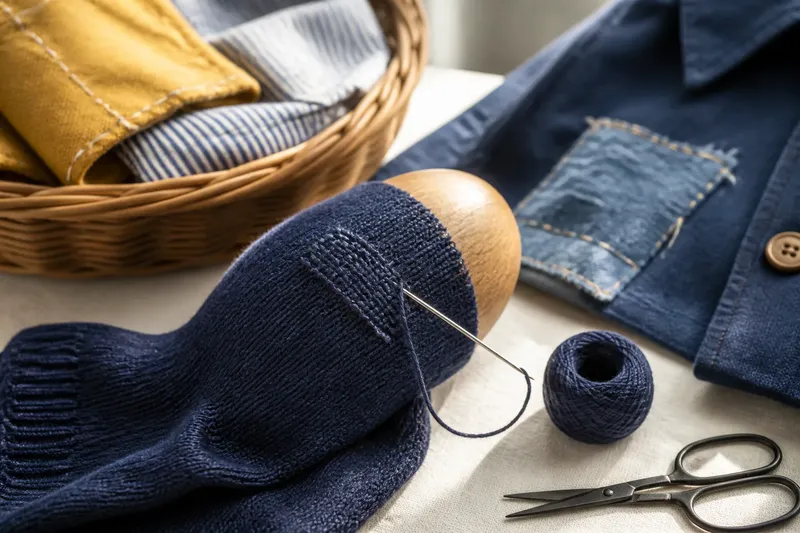
A hole in a wool sock could be worked over a wooden darning egg, while a patch on a child’s coat might remain plainly visible. Darning egg and visible mending history is not a simple story of hidden repairs giving way to decorative ones: people have mended for different reasons, with different materials, across changing circumstances.
How did the darning egg support everyday repair?
A darning egg is a smooth, rounded tool placed inside a sock, sleeve, or other curved section of cloth. It holds the damaged area open and steady while a needle carries thread across a hole. The mender weaves stitches into sound fabric around the weak spot, building a flexible darn rather than pulling the edges together into a tight seam.
Wood is a familiar material for darning eggs, but examples have also been made from other materials. Some handles help the tool stay in place or make it easier to hold. A plain alternative, such as a smooth, suitably sized object, can serve the same basic purpose if it does not snag or stretch the cloth.
The tool belongs to a broader history of household sewing, not to one uniform tradition. A darn could be intended to blend into a stocking, but a repair’s appearance depended on the yarn and cloth at hand, the mender’s skill, and the garment’s use. Matching color and thickness could make a repair less conspicuous; the practical aim was often simply to keep useful fabric wearable.
Why did mending look different from one household to another?
Clothing took time and resources to make, so extending a garment’s use could matter. But that does not mean everyone repaired clothes in the same way or held the same ideas about a neat finish. Available thread, local practice, household routines, the wearer’s needs, and the kind of damage all shaped the work.
A sock with a thinning heel called for a different repair from a tear in a woven shirt. A mender might darn a knit, sew a patch over weakened cloth, or reinforce an edge before it split. Some repairs were meant to be discreet; others were visible because the materials differed, the garment was heavily worn, or concealment was not the priority.
Claims about a single historical shift from universal thrift to careless replacement flatten those differences. Repair practices varied across communities and periods, and the survival of a patched garment does not, by itself, tell us why someone chose that method. It is safer to describe particular tools and techniques than to treat one household’s practice as everyone’s history.
When did visible mending become a deliberate style?
Visible repair is not a new human act: a patch can be seen whenever it contrasts with its cloth or sits on the outside. What has become more prominent in some contemporary craft settings is the deliberate presentation of mending as decoration or personal expression. That is a change in emphasis, not proof that earlier menders always hid their work.
Today, a maker may choose contrasting thread, a shaped patch, or a patterned darn to draw the eye to a repaired area. Another wearer may prefer a quiet fix that preserves the garment’s original appearance. Neither choice has one fixed historical meaning; the same visible stitch can reflect necessity, available supplies, skill, taste, or several of these at once.
How do discreet and visible repairs compare?
A discreet repair uses materials close to the garment’s color and weight, with stitches intended to draw little attention. It can suit a shirt worn under a jacket or a sock whose wearer prefers an unobtrusive finish. A visible repair makes the stitching or patch part of the garment’s appearance, but visibility alone does not make a mend sturdy.
A third option is a practical repair that is neither carefully camouflaged nor especially decorative. A close-colored patch with visible topstitching, for example, may look like straightforward maintenance. In every style, placement matters: a thick patch at a bend can feel uncomfortable, and decorative stitches may not support cloth that is badly weakened.
How can you choose a repair that suits the cloth?
Begin by identifying the fabric and the damage. A knit sock can stretch, so a rigid patch may restrict it; a woven shirt can fray at a torn edge, so the repair needs to secure sound fabric around the tear. Check whether the spot bends, rubs, or touches skin, then choose a finish that suits how the garment is worn.
- Check the fabric: If it stretches or is knitted, choose a repair that can flex; if it is a stable woven cloth, consider a patch with secured edges instead.
- Check the damaged area: If sound fabric remains around a small hole, stitch into that area; if the surrounding cloth is weak, reinforce a wider area or choose another repair method.
- Check the location: If the spot bends or rubs against skin, avoid a bulky patch there; if it lies on a less sensitive area, a more substantial patch may be comfortable.
- Check the available thread: If its weight suits the cloth, use it for a flexible, balanced repair; if it is much heavier or finer, find a better match before stitching.
- Check your preferred appearance: If you want the mend to recede, choose close colors; if you want it to show, select contrast while keeping the repair appropriate to the garment’s use.
- Check care guidance: If the label or fabric maker gives special washing instructions, follow them when selecting patch and thread; if no special guidance applies, choose materials suited to the garment’s ordinary care.
Say you have a navy cotton overshirt with a worn elbow, sound cloth around the thin area, and a small piece of sturdy muted-blue cotton. You decide that the repair should blend in, so you place the patch on the inside, trim away only loose threads, and use matching thread to stitch through the patch and the sound cloth around the weakened spot. Then you turn the shirt right side out and check that the elbow bends without pulling and that the stitches have not puckered the fabric. If the patch feels stiff or the cloth gathers, you loosen and redo the affected stitches; if it lies flat and moves comfortably, the result is a reinforced elbow with little contrast from the outside. Choosing mustard fabric instead would make the repair more visible, but would not by itself make it stronger.
What do people ask about darning eggs and visible mending?
What was a darning egg used for?
A darning egg supported a sock, sleeve, or similarly shaped area from inside while the mender stitched across a hole or thin spot. Its rounded surface held the cloth steady and kept fingers from blocking the work.
Is visible mending a new idea?
No: repairs have been visible whenever cloth or thread contrasted, or a patch was placed where it could be seen. Treating that visibility as a deliberate design choice is a more prominent feature of some contemporary craft practice, but it should not be confused with the entire history of repair.
Does a visible repair make a garment stronger?
Not by itself. The cloth’s condition, the method, and the location all matter; decorative stitches may look striking without supporting a stressed or badly weakened area.
Why choose a repair that can be seen?
A wearer may want to display handwork, add contrast, or make a repaired garment feel personal. Another may prefer camouflage; the choice depends on the cloth, the garment’s use, and the wearer’s taste.
What can a darning egg tell us about clothing history?
The darning egg offers a concrete glimpse of how a simple tool could support careful handwork, but it cannot stand for every mender or every period. Darning egg and visible mending history makes more sense when we keep the tool, the repair technique, and the repair’s social meaning distinct: each varied with the garment and the person doing the work.
When you encounter an old darn or patch, look first at where it sits, what cloth it joins, and whether the stitches follow a worn or torn area. Those details can suggest how the repair was made without asking one visible mark to tell a sweeping story about the people who wore the garment.